
Could AI and Robotics Redefine Everyday Life in Australia?
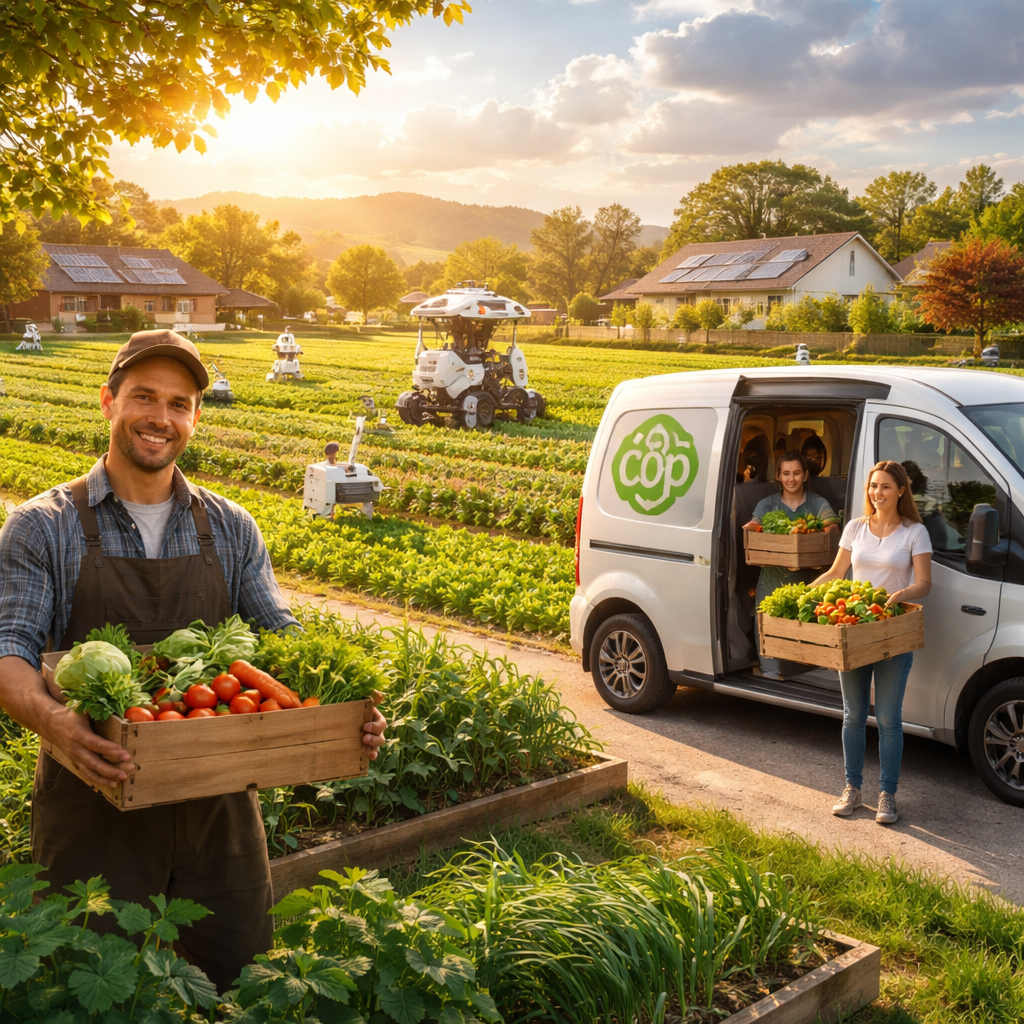
Imagine a future where fresh produce from a nearby farm arrives at your doorstep, harvested just hours earlier by robotic arms and delivered by driverless vehicles. Your lawn stays perfectly trimmed each week thanks to an autonomous mower you didn’t have to buy, schedule, or push around in the sun. The weekly grocery bill? Down — not because of a flash sale or loyalty points, but because the system behind it doesn’t exist to make a profit off you in the first place.
These kinds of technologies aren’t years away — they’re here now. What’s missing isn’t the innovation, it’s the way we bring that innovation to people.
Right now, most advances in AI and robotics are being absorbed into existing corporate structures. And those structures are designed for one thing: to maximise returns for shareholders. That means any savings from automation often stop at the profit line — trickling down slowly, if at all.
But what if communities had another option? What if there was a way to run essential services — food, home care, transport, even cleaning — using the same cutting-edge tech, but under a model where members, not shareholders, benefit?
We call this the New Guild: a modern take on the co-op. It’s not about charity or utopia — it’s about real savings delivered through smarter ownership. Members pool resources, use automation to bring down costs, and keep control local. No CEOs pulling levers from a boardroom. No inflated margins. Just practical, people-first economics.
So we asked ChatGPT: Where in Australia could this actually work? Where are the right mix of urban density, nearby food production, and high living costs that make a New Guild not just possible, but powerful?
In the list below, you’ll find 15 cities and suburbs across Australia where this model could thrive — and where a new way of living could quietly begin.
15 Australian Areas Ripe for the New Guild Model
Introduction: A “New Guild” model refers to community-driven enterprises that leverage AI, automation, and cooperative (non-profit) structures to deliver goods and services at near-cost. By eliminating traditional profit margins and using robotics to boost productivity, such guilds could drastically reduce living costs. This is not science fiction – it’s grounded in real economics. Globally, there are early signs of this shift. In New Zealand, for example, a supermarket duopoly leaves farmers with only ~15¢ of each food dollar and consumers paying above-OECD-average grocery prices. In response, a “Community Grocer” has launched to sell staples online and funnel all profits to foodbanks, embodying the guild ethos. In the US, remote regions like Hawaii suffer steep mark-ups (a gallon of milk costs ~$7.70 in Hawaii versus $3.99 on the mainland), while tech hubs face sky-high service costs. Solutions are emerging: Hawaii is investing in local vertical farming to cut imports, and startups are deploying autonomous service robots – for instance, Graze Robotics in Texas uses AI-guided mowers to trim landscaping costs by over 30%. These examples show how automation plus non-profit models can deliver big savings. Below we explore 15 urban areas in Australia where the economics suggest a New Guild model could thrive, by tackling high prices or labor constraints with innovation and cooperation.
Sydney, NSW – Australia’s largest city is also its most expensive. Sydney’s cost-of-living index ranks highest nationally (No. 37 globally), reflecting pricy groceries, transport and especially housing. High wages mean services (from childcare to home maintenance) come at a premium. A New Guild here could focus on essentials – e.g. cooperative grocery networks and automated delivery – to bypass retail mark-ups. By using AI and bulk-buying, a guild market could offer food at far below supermarket prices (since Australian farmers currently get under 15% of what consumers pay). Likewise, autonomous service robots (for cleaning, repairs, etc.) supervised by guild members could markedly cut Sydney’s steep labor costs while charging only at-cost fees.
Melbourne, VIC – Melbourne’s living costs closely trail Sydney’s, with its index only slightly lower (about 60.9 vs Sydney’s 67.6). As a cultural and tech hub, Melbourne has both high consumer prices and a tech-savvy workforce – ideal conditions for a guild model. For example, fresh produce and groceries in Melbourne are pricey due to supply chains and supermarket margins. A guild-operated urban farm and farmers’ co-op in Melbourne could leverage automation (hydroponics, AI crop management) to supply locals at minimal markup. This city also has many young professionals paying top dollar for conveniences (meal deliveries, laundry, etc.). A cooperative platform using AI (like routing algorithms or delivery drones) could meet these needs far cheaper by eliminating the profit layer. In short, Melbourne’s combination of high costs and innovation culture makes it fertile ground for a New Guild economy.
Brisbane, QLD – Queensland’s capital historically had a lower cost of living than Sydney/Melbourne, but that gap is closing. Especially in the past two years, Brisbane has seen sharp rent hikes and inflation in food and fuel. The city’s population boom (from interstate migrants) is straining services and driving prices up. A New Guild in Brisbane could address these pressures directly. For instance, a guild-owned fleet of autonomous minibuses could provide ultra-low-cost transport in sprawling suburbs, undercutting expensive car commutes. In groceries, Brisbane benefits from nearby farming regions – a guild might organize direct farm-to-city distribution using AI logistics, saving on supermarket retail trade add-ons (which consume ~20¢ of every food dollar). By focusing on cost-price services in housing construction, food delivery, and transportation, a Brisbane guild could keep living expenses in check even as the city grows.
Perth, WA – Isolated by geography, Perth suffers some of the nation’s highest grocery prices. Western Australia’s limited supermarket competition (no Aldi presence until recently) and long supply lines mean basics cost more. The CHOICE survey confirmed WA food bills are among the priciest in Australia. A New Guild model could dramatically improve affordability here. Perth could develop cooperative warehouses that bulk-import staples and sell at cost, or invest in automated greenhouses to localize veggie production (cutting transport costs). WA is also a high-wage mining economy – trades like yard maintenance or home repair are very expensive due to labor scarcity. A guild-owned equipment pool with semi-autonomous tools (drones for roof inspections, robotic lawn mowers, etc.) could let one skilled human oversee multiple jobs, lowering service fees. In essence, Perth’s remoteness and high wages make it ideal for an automation-assisted guild to trim fat from consumer prices.
Adelaide, SA – Adelaide currently has the third-highest cost of living index in Australia, despite its smaller size. Factors include rising food prices and energy costs. The city is known for cooperative spirit (e.g. community gardens, farmers markets), which a New Guild could build on. South Australia has abundant solar energy – a guild might run solar-powered vertical farms or refrigerated food co-ops to slash grocery costs (keeping produce local and bypassing big-chain markups). Adelaide’s aging population also means growing demand for affordable home services. A guild could deploy AI scheduling and shared autonomous vehicles to coordinate in-home care, gardening, and repairs at minimal cost (since it wouldn’t seek profit, only to cover wages and upkeep). By leveraging community ownership and automation, Adelaide could become a showcase of how to live well for less.
Canberra, ACT – The nation’s capital is not far behind Sydney in living costs; in fact, excluding rent it’s only ~0.8% “cheaper” than Sydney and Canberrans often pay more for groceries and dining out. With a high-income, highly educated population, Canberra is ripe for an alternative economic model. A New Guild here could target the inflated prices of everyday needs in a city dominated by a few large retailers. For example, a cooperatively run childcare network augmented by AI (for scheduling, virtual tutoring, etc.) could drive down the famously high childcare fees. Similarly, a guild could import bulk food directly from farmers in surrounding NSW, selling to members at near wholesale prices (since retail and wholesale trade add ~30¢ on every food dollar). Canberra’s tech-savvy workforce and strong community ethos mean a guild platform (perhaps started among public service employees) could quickly gain trust. By removing profit and using smart automation, Canberra could demonstrate how to close the cost-of-living gap with larger cities.
Darwin, NT – Darwin’s small size and extreme remoteness make it one of Australia’s most expensive places for goods. In nearby NT communities, a basic grocery basket can cost more than double what it does in Sydney/Melbourne. The Northern Territory has no Aldi or Costco, leaving a duopoly and high transport costs. A New Guild model could be transformative here. Think of a guild-operated cold-storage hub at Darwin’s port that buys staples in bulk directly from Asia or southern Australia, then sells to locals with no markup beyond operating cost. That alone could save families thousands, given current remote store prices (e.g. $7.50 for a kilo of apples in NT vs $4.87 in cities). Additionally, Darwin’s climate is ideal for year-round solar-powered agriculture – a guild farm using robotics could supply fresh produce locally, avoiding freight expenses. For services like home repair where fly-in trades charge steep rates, a guild could maintain a roster of multi-skilled technicians aided by AI diagnostic tools, charging only a modest subscription. Darwin exemplifies where automation + a not-for-profit mindset could flip the economics from scarcity to abundance.
Hobart, TAS – Tasmania’s island economy faces unique challenges: everything from milk to machinery often carries extra shipping costs. To make matters worse, Tasmania has zero Aldi stores, leaving 49 Coles/Woolworths locations as an entrenched duopoly. With little competition, Tasmanians haven’t enjoyed the price breaks seen on the mainland. A New Guild in Hobart could change that by creating competition from a different angle – community ownership. For instance, a guild-run supermarket in Hobart (sourced directly from Tassie farmers and mainland suppliers) could operate at cost-plus-small-margin, undercutting the big chains. Even if the guild’s prices matched Coles/Woolies on some items, the key difference is any surplus funds would cycle back to members or be reinvested to lower prices further, not paid out as corporate profit. Also, Hobart’s hilly suburbs and aging population mean services like grocery delivery are in demand – a guild might deploy autonomous electric vans for deliveries, providing free or at-cost delivery for members (versus expensive private courier fees). By filling the competition void and innovating in distribution, a Hobart guild could substantially ease cost-of-living pressures on the Apple Isle.
Gold Coast, QLD – The Gold Coast’s booming population and tourism-driven economy have ironically made it Australia’s most expensive city for renters. The median house rent here hit $900/week in 2025 – $120 higher than Sydney’s median – illustrating the intense cost pressures on local households. Many service workers in this region earn modest wages in hospitality and tourism, yet face big-city expenses. A New Guild model on the Gold Coast could focus on housing and basic services. For example, a housing guild might construct cooperative living complexes with automated maintenance (using IoT sensors and robotic cleaners to reduce upkeep costs), offering units at below-market rents (since there’s no landlord profit). For day-to-day expenses, a guild-owned discount grocery outlet could tap into national wholesale networks – Consumer NZ notes that independent grocers holding 30–40% market share, as in Australia, help keep prices lower, so expanding community-owned retail in Gold Coast would similarly exert downward price pressure. Additionally, the Gold Coast’s sprawling suburbs mean residents spend heavily on car travel and lawn care. A guild could run autonomous shuttle buses for cheap local transit, and maintain a fleet of robotic lawn mowers that service neighborhoods at a fraction of the usual lawn-care fee (since one human supervisor can oversee 3 mowers at once). All these measures would allow this “paradise” city’s workforce to actually afford living there.
Newcastle, NSW – As a mid-sized city, Newcastle lacks the intense competition of bigger metros, which can mean higher relative prices in some sectors. Grocery prices in Newcastle have been found ~7% lower than Sydney’s, but many residents earn less than their Sydney counterparts, so affordability remains a concern. Newcastle is also transitioning from its industrial past, with pockets of unemployment and underused land that a New Guild could mobilize. One idea is a guild urban farming network: Newcastle’s suburbs have space for community greenhouses or fish farms run by semi-automated systems (hydroponic monitors, AI feeding schedules). These could supply cheap, fresh food to locals while providing training/jobs – much like Detroit in the US has used urban farms to fight food deserts. On the services side, Newcastle’s trades (plumbers, electricians) often charge travel time to cover large Hunter Valley distances. A guild could coordinate a shared dispatch system, using AI to cluster jobs and send the nearest available technician, cutting down costs for consumers. By fostering local production and more efficient service delivery, Newcastle’s guild model would keep wealth recirculating in the community rather than leaking out to distant corporate owners.
Cairns, QLD – Far North Queensland illustrates the challenges of distance. Cairns and surrounding towns historically have had few supermarket competitors (Aldi only began expanding here recently, citing “supply chain complexities” as a barrier). The result is higher prices for groceries and goods. At the same time, Cairns’ economy relies on tourism and agriculture, sectors with seasonal employment and income uncertainty. A New Guild in Cairns could harness the region’s strengths (sunshine, fertile land) to combat its cost issues. For example, a solar-powered guild cannery or freeze-drying facility could process local fruit glut during harvest season and sell it year-round cheaply – providing farmers a fair price and consumers low-cost tropical produce without shipping it 2,000 km south and back. On the automation front, Cairns could deploy maritime drones or small autonomous boats for coastal fishing under a guild coop, drastically reducing the cost of fresh seafood by cutting fuel and labor costs. Such innovations, owned by the community, would mean locals pay only the true cost of production. By eliminating profit margins and long-haul transport, a Cairns guild can make living in this beautiful but remote region far more affordable.
Townsville, QLD – Townsville, another northern city, faces similar economic geography to Cairns. Until 2025 it had only two major supermarket chains; Aldi’s CEO noted the company avoided far north Queensland (and NT/Tas) due to supply-chain hurdles – effectively leaving Townsville’s 180,000 residents with a duopoly. That likely kept grocery prices elevated and variety limited. A New Guild approach in Townsville could introduce much-needed competition and resilience. Picture a guild-owned local grocery that partners with nearby farmers of the Atherton Tablelands for direct sourcing, and uses AI inventory systems to minimize waste – it could offer staples for considerably less than the big chains (since it doesn’t need a 20%+ gross profit). Townsville’s status as a military and mining support town also means lots of transient workers living in rentals and company housing, often paying high rates for basic services. A guild could run a not-for-profit tool library and repair service for household needs, using a mix of skilled humans and AI diagnostics to fix appliances, cars, or electronics at-cost – saving residents from expensive replacements or contractor call-out fees. With its strong community identity, Townsville is primed to rally behind a model that ploughs savings back to locals instead of corporate headquarters.
Alice Springs, NT – Deep in Australia’s interior, Alice Springs epitomizes the high cost of remoteness. Almost all food and fuel are trucked in across vast distances, leading to hefty price tags. In some remote NT communities, a basket of basic groceries costs over 120% more than in major cities – and while Alice itself might not hit that extreme, residents certainly pay more for fresh produce and groceries than Australians elsewhere. The New Guild model could revolutionize life in places like Alice. One solution is automated local production: small-scale robotic farms or 3D printing workshops for goods. For example, a guild could set up a hydroponic veggie farm run largely by AI (handling watering, nutrient mix, etc.), ensuring a steady supply of affordable greens year-round (no $10 lettuces like during supply shocks). Similarly, an array of solar-powered 3D printers and CNC machines could produce common household items or spare parts on demand – the guild members would pay just for materials and upkeep. Additionally, the guild might operate a community solar+battery grid to lower energy costs (often a big component of expenses in the hot interior). By embracing self-sufficiency through technology, Alice Springs could break free from the “tyranny of distance” and serve as a blueprint for sustainable, low-cost living in remote towns.
Pilbara Region, WA – The mining towns of the Pilbara (such as Karratha, Port Hedland, Tom Price) regularly top the charts as Australia’s most expensive places to live. The latest regional index showed the Pilbara’s cost of living is ~15% higher than Perth’s, with one town (Tom Price) nearly 30% more expensive than Perth overall. These high costs stem from isolation, a fly-in/fly-out work culture, and businesses charging a premium knowing mining salaries are high. A New Guild approach could alleviate some of this “price pain”. In the Pilbara, a guild might focus on infrastructure and collective services: for instance, a cooperative-owned airline or transport service for residents could break the monopoly of expensive flights and freight into the region. Automated drones or self-driving trucks (operated by the guild) could deliver goods from coastal ports to inland towns more efficiently and at lower cost than current logistics firms (which bake in high profit and risk margins). Moreover, mining towns often lack affordable fresh food – a guild could establish an AI-managed greenhouse in, say, Karratha, using excess mine heat or waste water to grow vegetables, selling them at cost to the community. By reinvesting mining wealth into local automation projects, the Pilbara’s guild could ensure the basic cost of living (food, transport, energy) comes down to earth even if global iron ore prices soar.
Sunshine Coast, QLD – The Sunshine Coast is a fast-growing urban area with a unique economic profile: a mix of retirees (seeking a quiet life) and young families/professionals moving in for the lifestyle. Its median age is about 44 – significantly older than the national median – which means a large portion of the population is retired or semi-retired. This creates high demand for services like healthcare, home maintenance, and landscaping, but a relatively smaller labor force to supply them. A New Guild model could be a game-changer by augmenting human workers with automation. Lawn care is a perfect example in this suburban region. Instead of dozens of separate mowing businesses each seeking profit, the guild could own a fleet of robotic lawn mowers and self-driving support vans, employing a handful of technicians to monitor them. This setup would allow one human to service many times more clients than a traditional crew – current commercial robots already let a single operator oversee three mowers at once, and future models could expand that ratio. The result: residents get their lawns maintained for perhaps half the current price, since the guild’s goal is simply to cover costs plus equipment upkeep. Similarly, in home healthcare the guild might deploy assistive AI (like fall-detection sensors or telehealth kiosks) to amplify what each nurse or carer can do, keeping elder care affordable. The Sunshine Coast, with its combination of older population, strong community spirit, and need for efficient services, is an ideal test bed for the New Guild’s promise – using tech not to eliminate jobs, but to ensure everyone’s needs are met at minimal cost.
NZ and US Examples: It’s worth noting that the ideas above echo trends abroad. New Zealand, confronting a costly duopoly, has seen community supermarkets arise that return profits to social causes, and its regulators highlight how more co-ops could lower prices. In the United States, some high-cost regions are turning to automation to bridge the affordability gap – from Hawaii’s experiments in indoor farming to cut food bills (where island groceries run ~68% above mainland prices), to Silicon Valley companies using delivery robots and AI-driven services to cheapen everything from ride-hailing to food prep. The common thread is clear: by removing the traditional profit layer and embracing new technology, communities can dramatically reduce the real cost of living. The 15 Australian areas listed above each have unique economic pressures, but all stand to benefit immensely from a New Guild model that makes essentials cheaper and more accessible for everyone. Each could become a pioneer in showing how an automation-assisted cooperative economy isn’t utopian – it’s practical, financially sound, and ready to improve lives in the here and now.
Sources: The analysis draws on current cost-of-living data, technology case studies, and reports on cooperative initiatives to ensure all figures and scenarios are grounded in reality, not hype. Key references include government surveys (e.g. WA’s Regional Price Index), consumer advocacy research (CHOICE and ACCC inquiries), and real-world pilots of automation in services (such as Graze Robotics’ 30% cost savings claim and RC Mowers’ productivity stats). These illustrate that the New Guild concept can build on proven economic facts: streamlining supply chains, deploying AI/robotics, and eliminating profit-taking can yield substantial cost reductions for households. Each locality highlighted has the economic rationale to be a first mover in this emerging paradigm, setting a precedent for others to follow.