
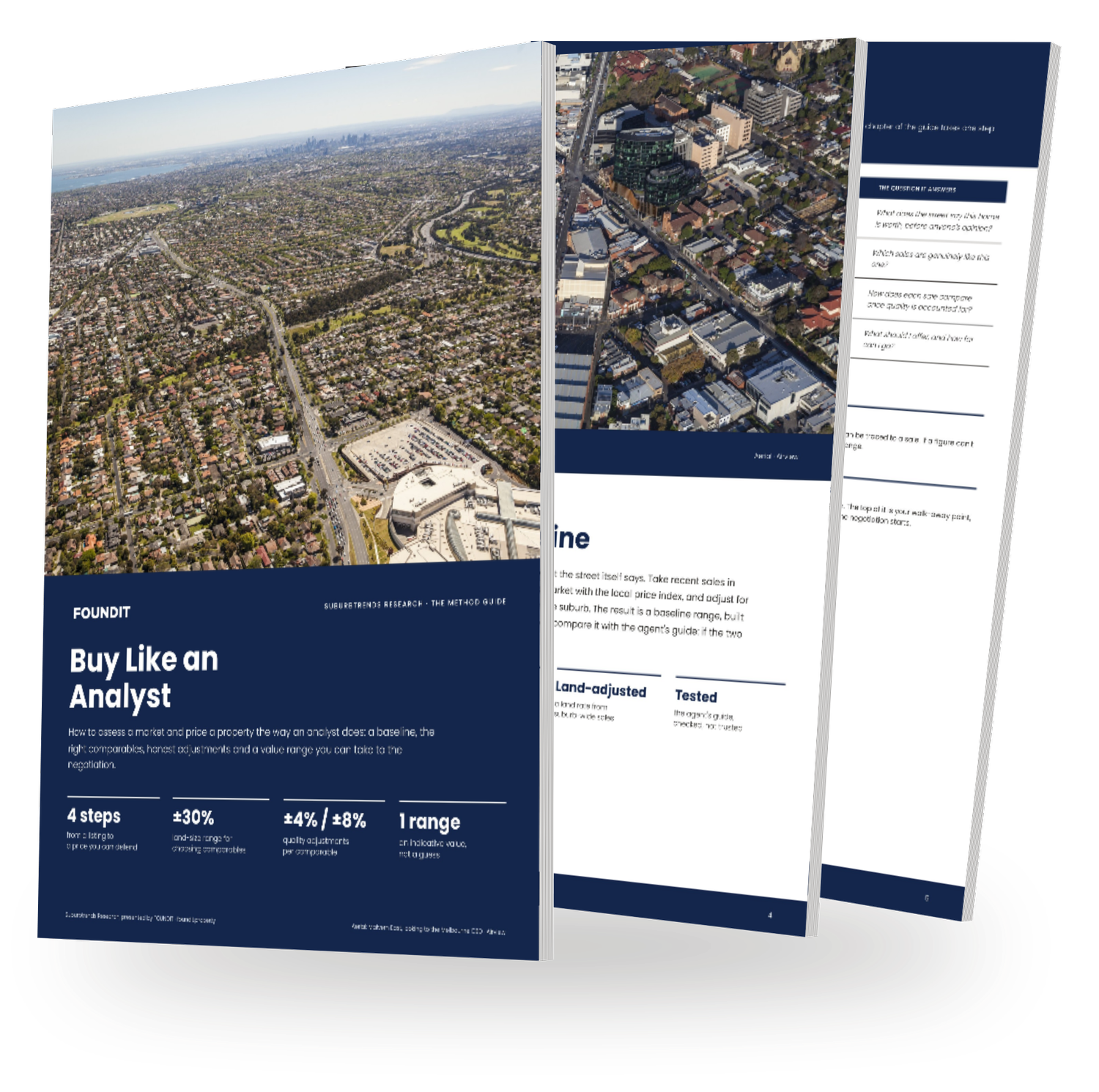
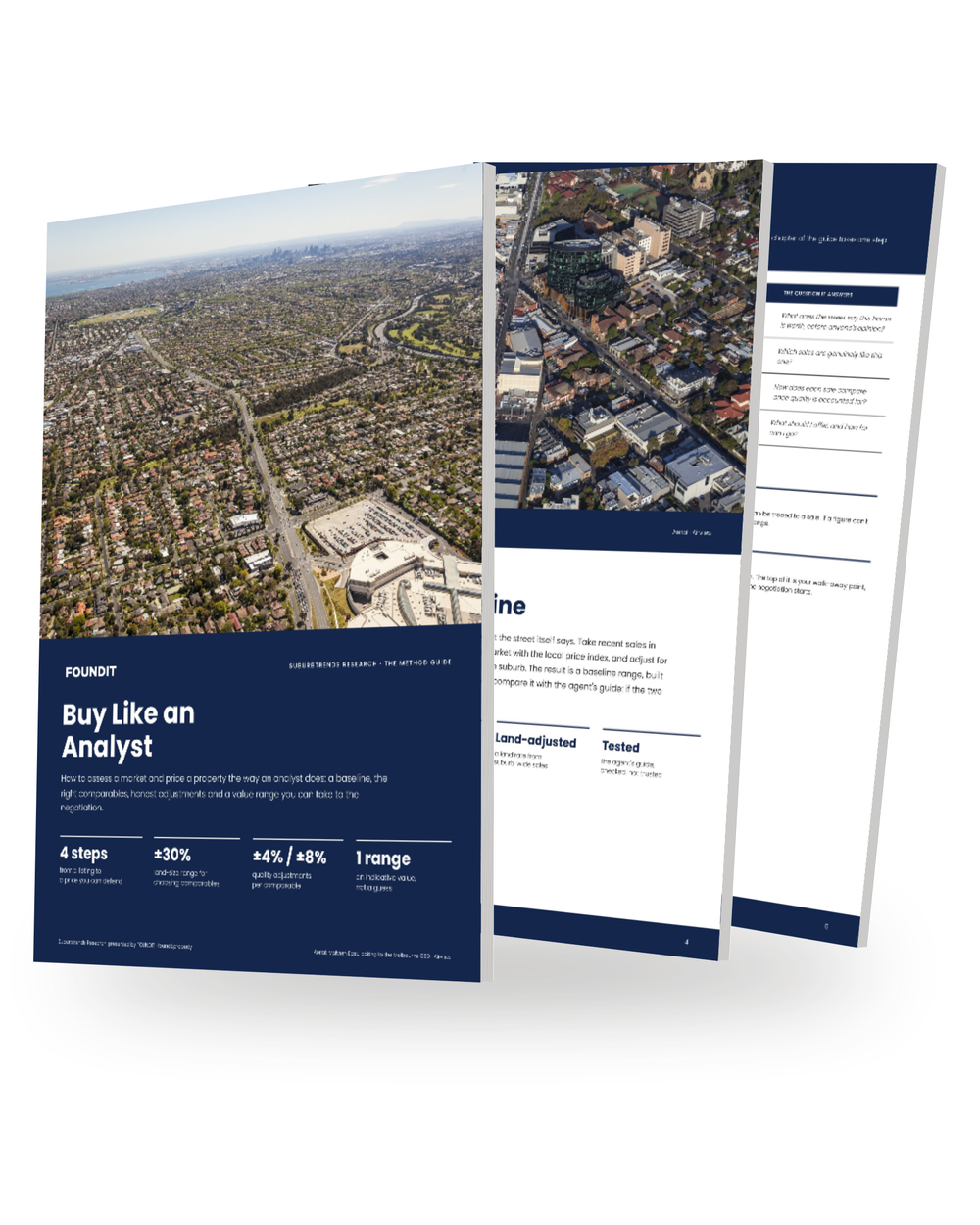
Buy Like an Analyst
How to assess a market and price a property the way an analyst does: a baseline, the right comparables, honest adjustments and a value range you can take to the negotiation. Get the guide free, worked through on the property you're looking at.
A price you can defend beats a price you were given.
Most buyers price a home from the agent's guide and a few sales they found online. Analysts work the other way round: they build a value from the evidence, then test the guide against it.
This guide sets out the same four-step method FOUNDIT uses for every buyer brief: set a baseline from same-street sales, scope the comparable search, grade each comparable honestly, and settle on an indicative value range.
It also covers the four habits that separate an analyst from an enthusiast, from reading the market first to deciding your walk-away point before the auction starts.
The four steps
- 1Set a baselineIndex same-street sales to today and adjust for land size
- 2Scope the searchComparables within ±30% of the land size
- 3Grade the comparablesAdjust each by up to 8% either way for quality
- 4Settle on a valueAn indicative range, set against the guide
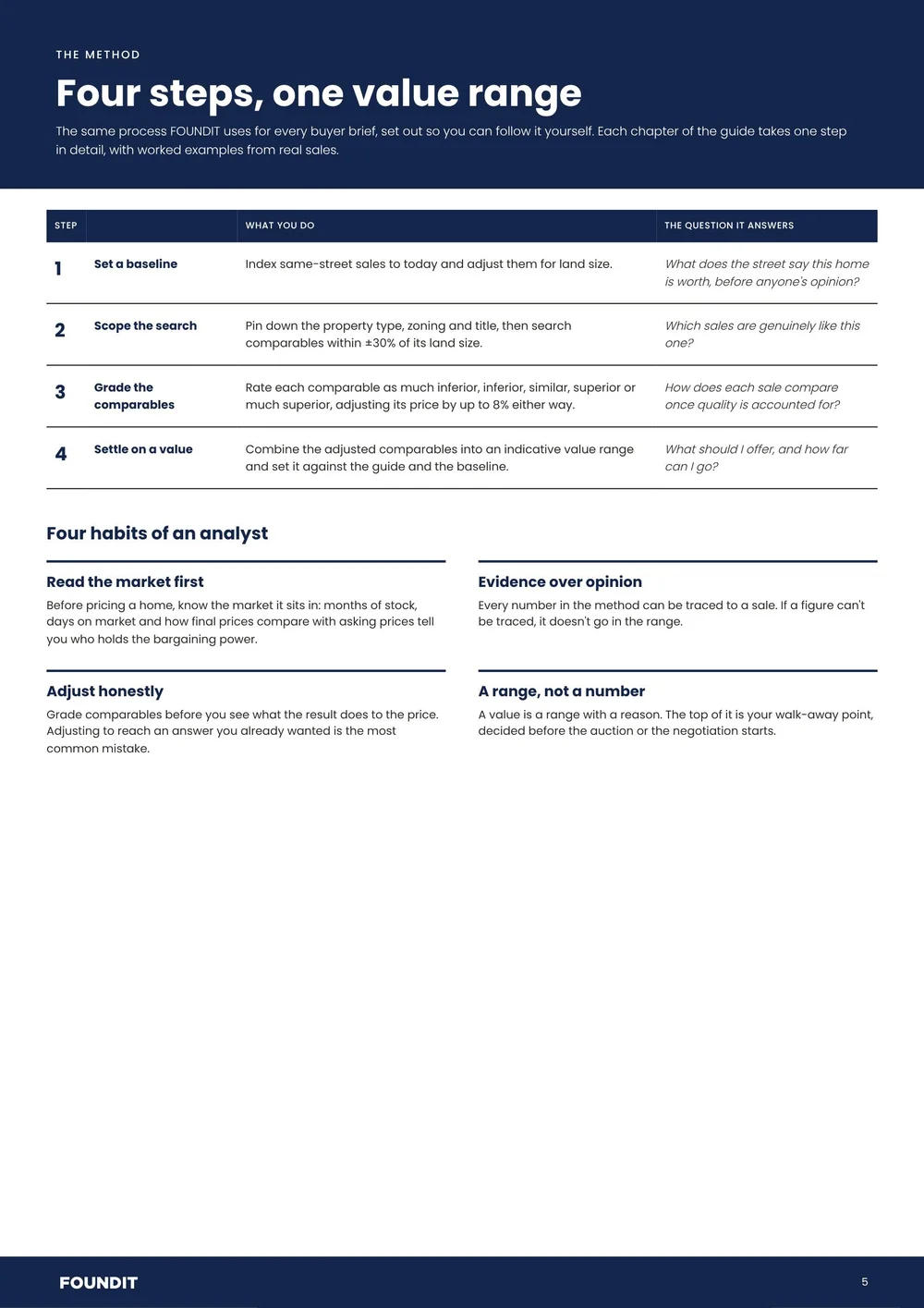
Four steps, one value range
The method, worked through on your property.
A method is most useful on a real home. Tell us a little about yourself and we use Claude, the AI model from Anthropic, to rebuild the report from the same Suburbtrends data around your brief: the property or suburb you're weighing up, the agent's guide, your budget and your timing. Kent Lardner, Head of Research at FOUNDIT, checks every tailored report before it's sent. It's free.
Tell us your brief
The property or suburb you're looking at, your budget and when you plan to buy. Two minutes.
We run the method
The four steps on the same Suburbtrends data: a baseline, the comparables, the adjustments and a value range.
It lands in your inbox
Your worked example by email. If you'd like to talk it through, book a call with Kent.
Writing about the market? Journalists get the data, charts and local cuts for their story, attributed to Suburbtrends Research.
Tell us what you need
The more you tell us, the sharper your version. We use your details only to build and send your report, and to follow up if you ask us to.
The method, step by step
1. Set a baseline: index same-street sales to today with the local price index and adjust them for land size using a land rate from suburb-wide sales. 2. Scope the search: pin down the property type, zoning and title, then search comparables within ±30% of its land size.
3. Grade the comparables: rate each as much inferior, inferior, similar, superior or much superior, adjusting its price by up to 8% either way. 4. Settle on a value: combine the adjusted comparables into an indicative value range and set it against the guide and the baseline.
Do I need to be a property professional to use this?
No. The guide is written for buyers. Every step can be done with public sales data and a spreadsheet, and the worked examples show how.
Is the report really free?
Yes. Both the report and your tailored version are free. If you'd like help acting on it, you can book a call with Kent, but there's no obligation.
How does the worked version work?
You tell us the property or suburb in the form above. We use Claude, the AI model from Anthropic, to run the four steps on the same Suburbtrends data, and Kent checks it before it's sent.
Is an indicative value the same as a valuation?
No. It is a buyer's evidence-based estimate to guide an offer. A formal valuation is done by a certified valuer, usually for a lender.
Is this financial advice?
No. It's general market research. Speak to a licensed adviser before making investment decisions.
Kent Lardner, Head of Research, FOUNDIT
Kent runs Suburbtrends, built to put the numbers buyers need in plain view: what's selling, for how much, how fast and where the negotiating power sits. Suburbtrends Research is presented by FOUNDIT, built on buyer-side analysis rather than sales spin.
Sources: Suburbtrends Market Trend and sales data. Aerial imagery: Airview. General information only, not financial advice.